Update 2026-04-05: I put the examples into a table instead of bullet points for improved comprehension.
Update 2026-04-09: I added references to the Akademio-de-Esperanto articles.
Motivation
One aspect of Esperanto grammar I am still struggling with, is verbs. I am by no means the only one. I do remember almost 3 years ago, I went back from the Universala kongreso in Turin after taking my B1 exam and being confused about the semantics of igi/iĝi suffixes. During the multi-hour ride, my friend and I built up a basic understanding along common explanation practices. About one year ago, I mentioned that I want to sum it up in a blog post and another Esperantist told me to share it, because they get confused about it as well. I do believe the accusative case and transitiveness are the two most common issues Esperantists struggle with. Unlike the former, I found the latter cannot be explained easily and to some extent they are intertwined.
Let’s dive into the topic of “how do Esperanto verbs operate?”
Verbs
Fundamentally, verbs in a language describe actions or relations between entities. “I love you” yields a (at least unidirectional) love between ‘I’ and ‘you’. “I became an Aikido trainer” yields that ‘I’ attained a certain property (or relation) ‘being an Aikido trainer’.
Linguistic concepts
If we look at other languages, there are various associated concepts. I am going to use languages I am familiar with here.
-
In German, one can say “Ich backe einen Kuchen” (en. “I bake a cake” or “I am baking a cake”). In my elementary school, one of the biggest deals was understanding that ‘Ich’ is a subject and ‘einen Kuchen’ is an object. The concept of subject/object is fundamental, but my favorite linguist taught me that this concept is language-specific and easily misunderstood. But we are going to stick to it here. In this German sentence, the nominative element is unambiguously ‘Ich’ (accusative would be ‘mich’) and the accusative element is ‘einen Kuchen’ (nominative would be ‘ein Kuchen’). So we just define that the subject is the element in nominative case and the object is in the accusative case. And in Esperanto we can use the same terminology, since every accusative element is distinguishable from the nominative element by the -n suffix.
-
In German, I can turn around the sentence and hide the subject: “Ein Kuchen wird gebacken” (en. “A cake is baked” or “A cake is being baked”). Here, we have no accusative. Recognize that the object in the previous example is the subject in this example. This form is what is called passive voice. There is no similar concept like this in Esperanto.
-
The previous examples showed an interesting concept: there is an acting entity (‘Ich’) and some entity acted upon (‘Kuchen’). Linguists call it agent and patient. This is semantic property and does not change by the example sentence structures. In both cases, the cake is the patient and the agent is I (even if it is only implicit in the second example). The sentence “I moved the pen to the table edge” has more than two entities. ‘I’ am acting on ‘the pen’ and the final entity ‘table edge’ might need another thematic role besides agent or patient. More semantic roles need to be defined. Manfred Krifka lists more roles for German like an instrument or a locator. Whereas the agent/patient model is basic and easy to explain, advanced models require explanations beyond what we try to achieve here.
-
Christer O. Kiselman wrote an elaborated text “Transitivaj kaj netransitivaj verboj en Esperanto” covering the topic of this blog post. He uses the word valento (en. valence). The verb is enriched by one, two, or more entities. By sentence structure and their convention, you know how those entity relate to each other. Whereas the agent/patient/… model assigns semantics to each element, the valence-model only counts and does not necessarily assign anything. So to understand Esperanto verbs better, I suggest to study its thematic roles as well.
-
I just claimed “the verb is enriched by one, two or more entities”. Does Esperanto have verbs without entities? Does Esperanto have complete sentences only with one verb? Yes. Esperanto defines that weather-related sentences may skip the subject. “Pluvas” means “It is raining” and skips the generic ‘It’, we find an English.
-
When breaking it down like Kiselman, one could claim that verbs have a valence of one or two, but this is missing crucial information. We neither specify the semantics (e.g. agent/patient) nor is it a complete model (i.e. covers verbs with zero entities). So I oppose explanations of verbs which emphasize whether the verb is transitive (has valence 2) or intransitive (has valence 0 or 1).
To conclude:
-
Esperanto verbs require zero, one, two, or more entities.
-
Some people might argue that valence zero does not exist because valence zero just means ‘ĝi is implicit’. That’s okay. I consider a different model here.
-
{agent/patient, agent/patient or more, valence, (in-)transitive} are models to explain how entities relate to the verbs
The curious case of igi/iĝi
Well, various verbs take an -igi or -iĝi suffix. More specifically, the following statements are true:
-
Some verbs only exist in their pure form (e.g. aparteni).
-
Some verbs only exist with an -igi suffix (e.g. listigi).
-
Some verbs only exist with an -iĝi suffix (e.g. ellitiĝi).
-
Some verbs exist in the forms {pure, -igi} (e.g. ŝajni, ŝajnigi).
-
Some verbs exist in the forms {pure, -iĝi} (e.g. levi, leviĝi).
-
Some verbs exist in the forms {-igi, -iĝi} (e.g. publikigi, publikiĝi).
-
Some verbs exist in the forms {pure, -igi, -iĝi} (e.g. koncentri, koncentrigi, koncentriĝi).
Let me sum it up: All combinations are possible. But I won’t claim that all dictionaries agree. Whereas the previous items might have slight differences between dictionaries, the last one is uncommon. The words koncentri, koncentrigi, and koncentriĝi exist in PReVO and reta-vortaro which use the same dataset (but apparently different versions because differences can be found in e.g. publiki), but PIV and glosbe deny the existence of -igi.
Sources
When mentioning dictionaries, I refer to these four:
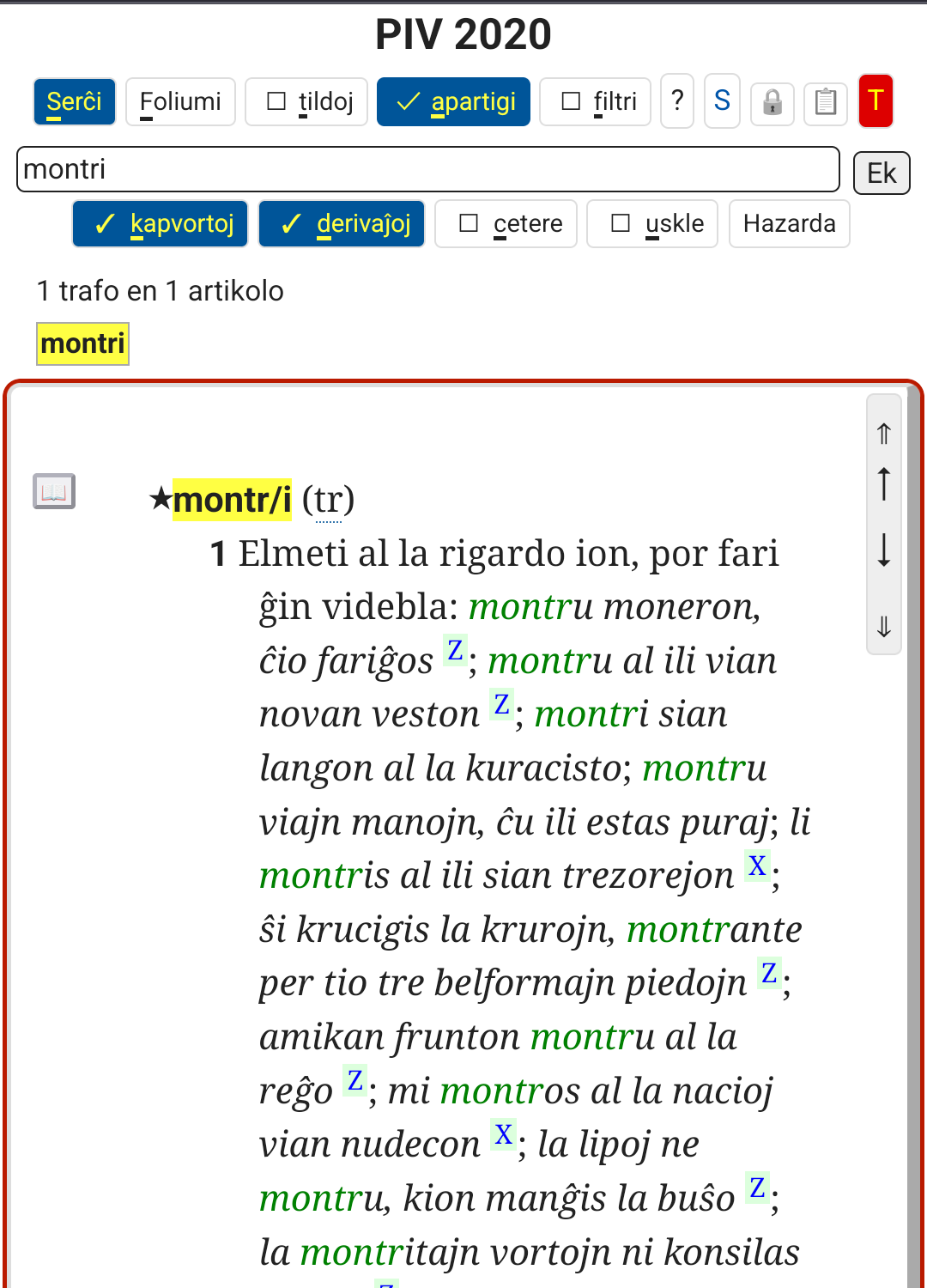
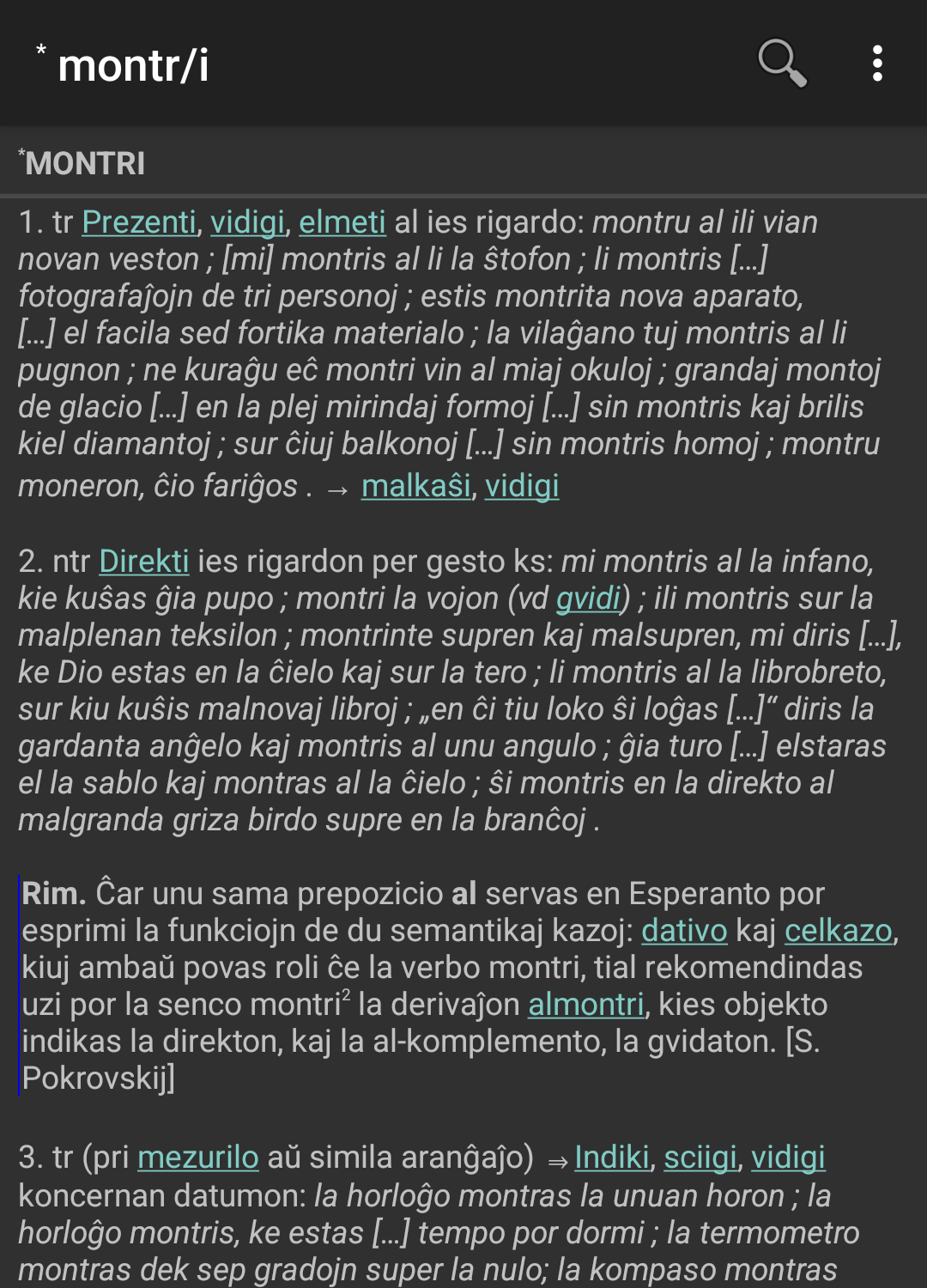
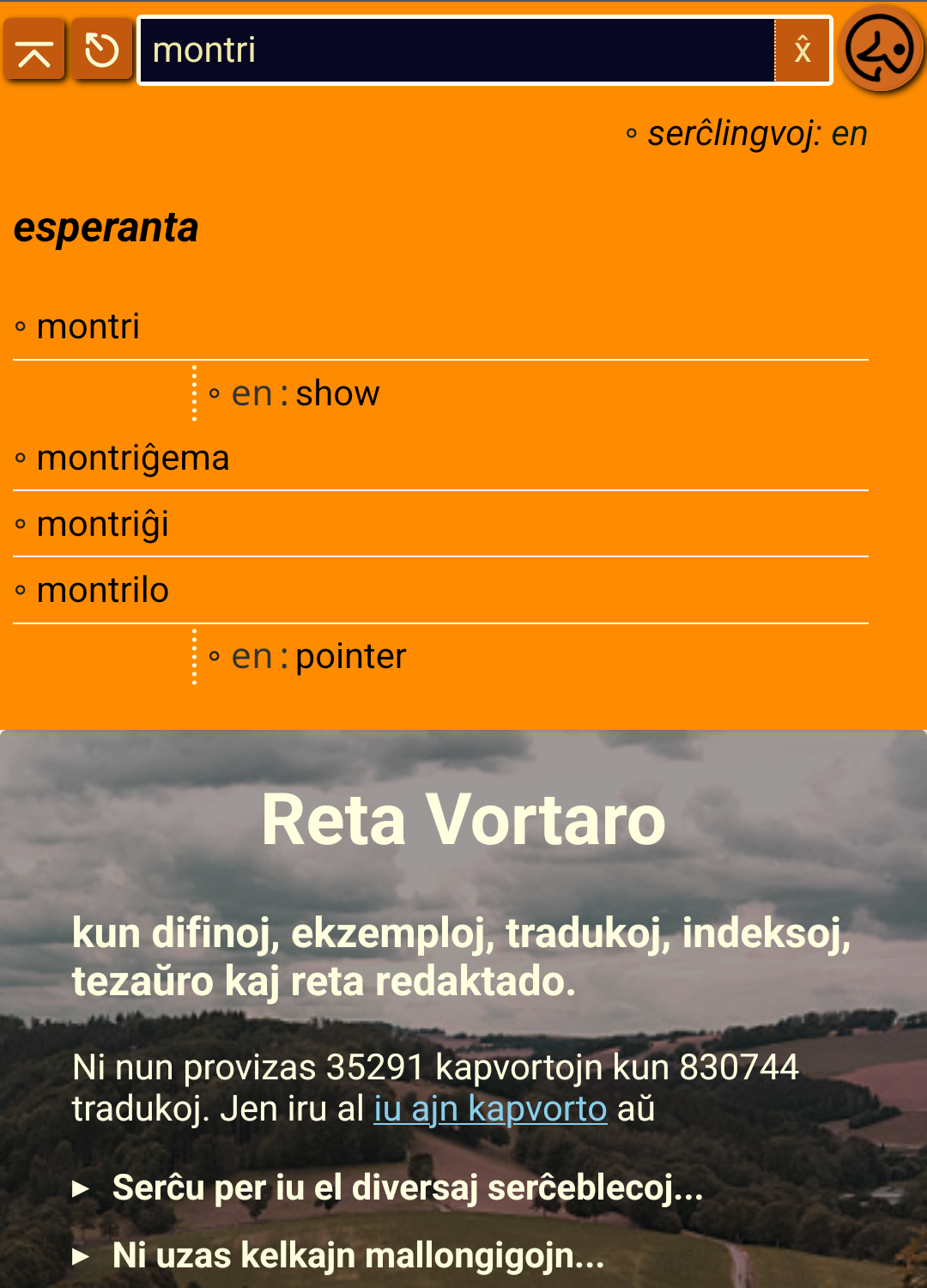
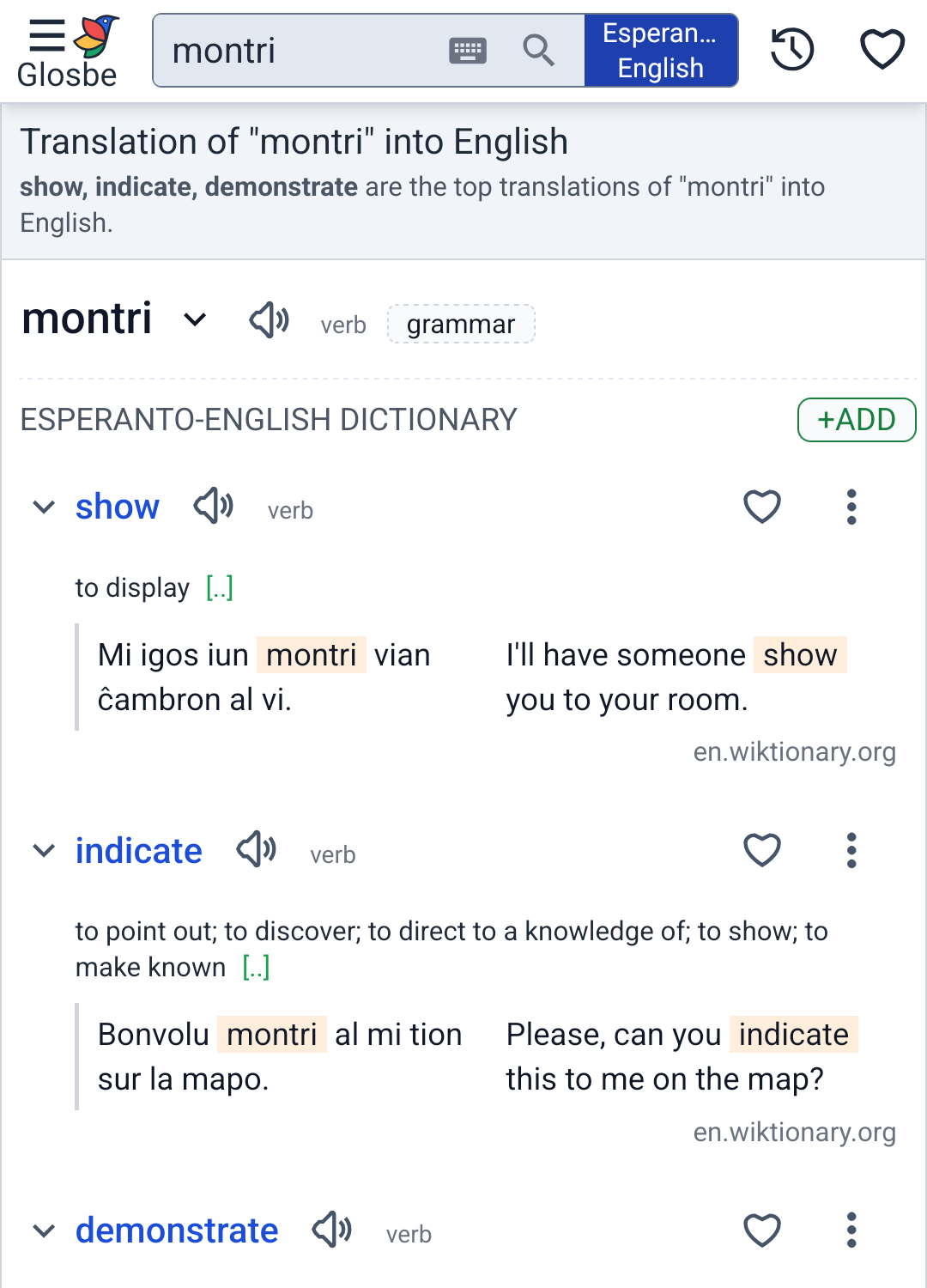
As you can see, the first two dictionaries mention whether verbs are transitive (abbreviated as tr) or intransitive (abbr. ntr). So you have some clue about its valence. I chose ‘montri’ specifically, because it is an example verb which can be used transitive and intransitive.
Esperanto examples
| verb | exists | example | En. translation | En. meaning | Model instance | valence | transitive? |
|---|---|---|---|---|---|---|---|
levi |
yes |
“Mi levas la libron” |
to lift |
I lift the book |
I = agent, book = patient |
2 |
transitive |
leviĝi |
yes |
“La birdo leviĝas” |
to rise |
The bird rises. |
Birdo = patient |
1 |
intransitive |
levigi |
no |
||||||
ĝeni |
yes |
“Mi ĝenas mian edzinon” |
to bother |
I am an inconvenience to my wife. |
I = agent, edzino = patient |
2 |
transitive |
ĝeniĝi |
yes |
“Mi ĝeniĝas” |
to be bothered[1] |
I am bothered (‘by whom’ is unknown). |
I = patient |
1 |
intransitive |
pravi |
yes |
“Vi pravas” |
to be right |
You are right. |
you = patient |
1 |
intransitive |
pravigi |
yes |
“Nun vi pravigu vian kalkulrezulton” |
declare/show to be right |
You should show that your calculation result is right |
you = agent, kalkulrezulto = patient |
2 |
transitive |
praviĝi |
yes |
“Per eraro la faro ne praviĝas” |
to be corrected/turned right[1] |
With the help of an error, the happening cannot be turned right |
faro = patient |
1 |
intransitive |
enliti |
no |
||||||
enlitigi |
only in globse |
“La patro enlitigas la filinon” |
to put to bed |
The father put the daughter to bed |
father = agent, daughter = patient |
2 |
transitive |
enlitiĝi |
yes |
“Adam frue enlitiĝis pro la laboro” |
to go to bed |
Adam early went to bed because of work |
Adam = patient |
1 |
intransitive |
aparteni |
yes |
“La gratuloj apartenas al la partoprenantoj” |
to belong |
The wishes belong to the participants |
(does not fit - wishes is not an ‘agent’) |
(does not fit) |
(does not fit) |
The interesting thing about the last example is that ‘aparteni’ may not be used without preposition ‘al’. So there is no object, but a compulsory preposition. So if your intuition is that all prepositional phrases are optional, this example is a counterexample. Does this compulsory preposition increment valence by one? If your answer is yes, then the valence is two and ‘aparteni’ is transitive. If your answer is no, then the valence is one and ‘aparteni’ is intransitive.
The following universal statements can be made:
-
Given a verb, the -igi suffix adds another entity to the sentence structure. The additional entity increases the valence by one.
-
Given a transitive verb, the -iĝi suffix removes some entity because the transitive sentence structure ‘agent verb patient’ corresponds to ‘patient verb-iĝi’. It decreases the valence by one.
-
Weather-related verbs never have -igi or -iĝi forms.
-
Any description with valence or transitiveness breaks once we encounter a verb like aparteni which requires a subject and a pri-preposition. Valence 2 usually means subject-and-object, but here it means something different.
The following incomplete statements or ideas can be expressed:
-
For igi-verbs, the additional entity has the notion of “initiating/instigating an action”. In English, the -igi verb would be expressed as “to be made to” or “to be instigated to”. But this English explanation does not fit e.g. for ‘pravigi’ where the subject does not instigate the object but the subject has to show the object.
-
If some transitive verb describes that the agent performs an act using the patient, the verb with -iĝi describes that the patient is in the state of the described act. In English, this is similar to passive voice.
-
If some verb and its counterpart with prefix mal- exist[2], they are usually used with the same structure. This is rarely true for other affixes.
How verbs shall be taught in my opinion
I do believe I am interested in the topic, because I just learned verbs in the wrong way autodidactically. Whereas English teachers in high school showed me patterns how to use verbs, I mostly studied translations for Japanese and Esperanto. In Anki, I can find plenty of examples:
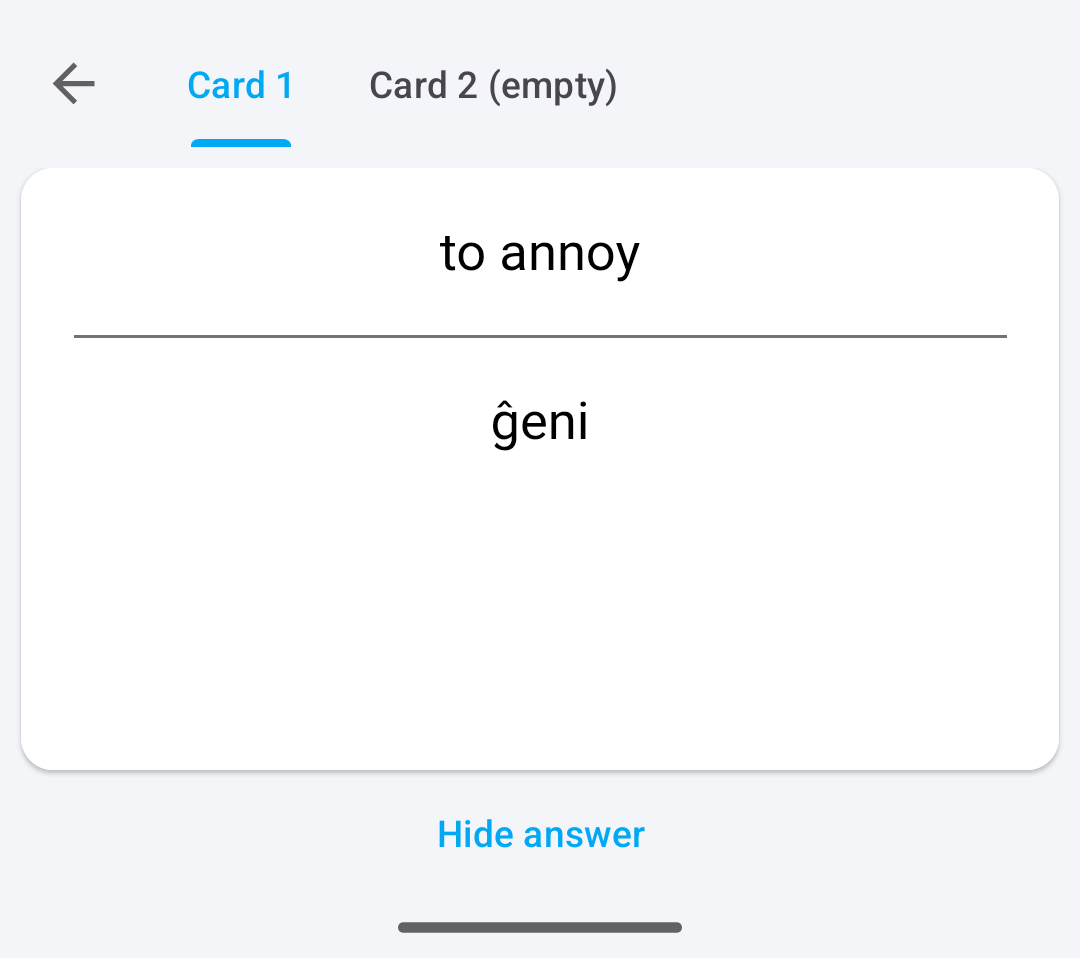
In summary, there are verbs used like …
-
‘verb’ which is limited to weather-related statements in Esperanto.
-
‘A verb’ where A is an agent followed by optional ‘preposition C’ patterns in any ordering.
-
‘A verb B’ where A is a patient followed by optional ‘preposition C’ patterns in any ordering.
-
‘A verb B’ followed by optional ‘preposition C’ patterns in any ordering.
-
‘A verb preposition B’ followed by optional ‘preposition C’ patterns where preposition phrases have any ordering. Unlike C, B is required.
Now it would be completely wrong to claim that the semantics of the verb together with the sentence structure exists equivalently in every other language. Hence it does not suffice to study its translation alone. It neither suffices to know which valence a verb has or more trivially whether it is transitive or intransitive. Instead I should study a verb together with examples for the sentence structures which exist in Esperanto. This way one should be able to engrave into one’s brain the structures a verb may be used with.
Official statements regarding igi and iĝi
The Fundamento does not clarify the aforementioned details. In general, the Fundamento avoids linguistic clarifications and presents the language by examples. Specifically, igi is presented the following way:
ig faire…; ex. pura pur, propre ― purigi nettoyer; morti mourir ― mortigi tuer (faire mourir) | cause to be; e.g. pura pure ― purigi purify; sidi sit ― sidigi seat | zu etwas machen, lassen; z.B. pura rein ― purigi reinigen; bruli brennen (selbst) ― bruligi brennen (etwas) | дѣлать чѣмъ нибудь, заставить дѣлать; напр. pura чистый ― purigi чистить; bruli горѣть ― bruligi жечь | robić czemś; np. pura czysty ― purigi czyścić; bruli palić się ― bruligi palić.
… and iĝi is introduced with the following examples:
iĝ se faire, devenir…; ex. pala pâle ― paliĝi pâlir; sidi être assis ― sidiĝi s’asseoir | to become; e. g. pala pale ― paliĝi turn pale; sidi sit ― sidiĝi become seated | zu etwas werden, sich zu etwas veranlassen; z. B. pala blass ― paliĝi erblassen; sidi sitzen ― sidiĝi sich setzen | дѣлаться чѣмъ нибудь, заставить себя; напр. pala блѣдный ― paliĝi блѣднѣть; sidi сидѣть ― sidiĝi сѣсть | stawać się czemś; np. pala blady ― paliĝi blednąć; sidi siedzieć ― sidiĝi usiąść.
-
The Akademio de Esperanto has published two remarks about the reflexive form which is a special case of our discussed topic: ‘Pri la uzo de la refleksivoj’ (1971) and its sequel ‘Pri la refleksivo’ (1976).
-
One official information clarifies how to annotate agents in the context of participles: ‘Esprimo de la aganto en komplementa funkcio’ (1986).
Conclusion
-
Dictionaries do not agree about usages of verbs. I do believe because first, it is difficult to cover how people use language (e.g. is “Ich ende” a valid sentence in German?) and second, the very strong multilingual influence for Esperanto leads to new (often superfluous) patterns all the time.
-
Subject and objects are implicit arguments for a verb. Other arguments are provided with explicit prepositions which already give a hint how they relate to the verb.
-
The concepts of valence and (in)transitiveness and do not cover the true complexity of verb usage.
-
Verbs in -igi forms usually mean that the subject instigates the action. Verbs in -iĝi form usually mean that the subject is passively in a state and it does not state who is acting upon the subject.
Finally, I understood this topic good enough!